The Majesty of the Incarnation
O God, who through the child-bearing of the holy Virgin graciously revealed the radiance of your glory to the world, grant, we pray, that we may venerate with integrity of faith the mystery of so wondrous an Incarnation and always celebrate it with due reverence.
O Root of Jesse’s stem, sign of God’s love for all his people: come to save us without delay!
There is an air of majesty and wonder in today’s collect. It has the radiance of glory, mystery, and reverence, and all of this before the great mystery of the Incarnation. To help us in our reflection today, I would like to cite from Bishop Wall’s exhortation on the Eucharist, wherein he discusses the truth and power of the Incarnation.
Saint John the Evangelist begins his Gospel with one of the most fascinating portions in all of Scripture (cf. Jn. 1:1-18). Whether examined for its literary qualities or its theological profundity, it has always provided a deep well from which to draw spiritual nourishment. So important have these verses been in the life of the Church that they have often been read over the faithful as a reminder of the great work that God had accomplished in Christ.
Now, right at the heart of these verses is the truth that changed the world: “And the Word became flesh and dwelt among us, full of grace and truth; we have beheld his glory, glory as of the only-begotten Son from the Father” (Jn. 1:14). Elsewhere Saint Paul would describe the same matter this way as he sought to describe the reality of the Incarnation: “But when the time had fully come, God sent forth his Son, born of woman, born under the law, to redeem those who were under the law, so that we might receive adoption as sons” (Gal. 4:4). Essentially, what both of these saints are describing is the fact that the Father sent the Son to take on our human nature by assuming it unto His Divine Personhood. The Son became like us in all things but sin (cf. Heb. 4:14-16). This matter was then later taken up in the Church’s solemn profession of faith at the Council of Nicaea in the year 325. From that day to this, we pray regularly that “for us men and for our salvation he came down from heaven; and by the Holy Spirit, was incarnate of the Virgin Mary, and became man.”
What this brief line from the Creed shows us is that the Church has long asked the question “Why did God become man?” In other words, what was the purpose of the Incarnation, and, by extension, what impact does it have on my life? This is in fact a question should arise in the heart of every believer, for by asking it, one is forced to wrestle with the almost incredible truth that God is one of us (cf. Mt. 1:18-23; Lk. 1:26-38); that in His Incarnate Son, God chose to humble Himself to be like us (cf. Lk. 2:1-7; Ph. 2:6-11), to live with us (cf. Lk. 2:39-40), to have needs (cf. Lk. 19:31), and even to undergo temptations (cf. Mt. 4:1-11; Lk. 4:1-13), suffering, and death (cf. Mt. 26-27; Mk. 14-15; Lk. 22-23; Jn. 18-19). The more one meditates on these facts and passages, the more he is forced to recognize the “marvelous exchange” that takes place in Christ: the Creator becomes a creature, so as to show creatures the way back to the Creator.
Already this gives a first answer to the question we just proposed. Why did God become man? So that we could be taken back to God after we had been lost in sin (cf. e.g. Lk. 15). This is not the only answer to the question, however. Many saints and doctors of the Church have had varying answers to the “why” of the Incarnation, and each gives a glimpse of the whole truth. Holy Mother Church for Her part has summarized all of these into four essential points. She says that the Word became flesh:
—in order to save us by reconciling us with God (cf. I Jn. 4:10; 4:14; 3:5), —that we might know God’s love (cf. Jn. 3:16; 1 Jn. 4:9), —to be our model of holiness (cf. Mt. 11:29; Mk. 8:34; 9:7; Jn. 14:6; 15:12) —and to make us partakers of divine nature (cf. 2 Pt.1:4).
In each of these reasons we see God’s immense desire to unite us to Himself so intimately and closely that He became one of us. So great is this gift of God Himself to mankind that no greater gift could be given. As humble recipients of such a gift, we should always seek to make some return to the Lord for all of His goodness to us (cf. Ps. 116:12). This happens, of course, in our prayers of thanksgiving and praise, and by our way of life, which is meant to reflect Christ to the world (cf. Gal. 2:20).
Reflection Questions
- Do I understand what the Church means by Incarnation, especially in this season, so close to Christmas? If not, do I take the time to study this saving truth?
- Do I marvel at the reality that God became man, or take it for granted, even being unthankful for it?
- Why reason to the Incarnation struck my heart the most? What does that reason mean, in itself and to me?
- What do I need to ask of Christ at Christmas, when His Incarnation is made manifest to the world? What do I need to give to Him in the manger?
The Cristeros Rule of Life
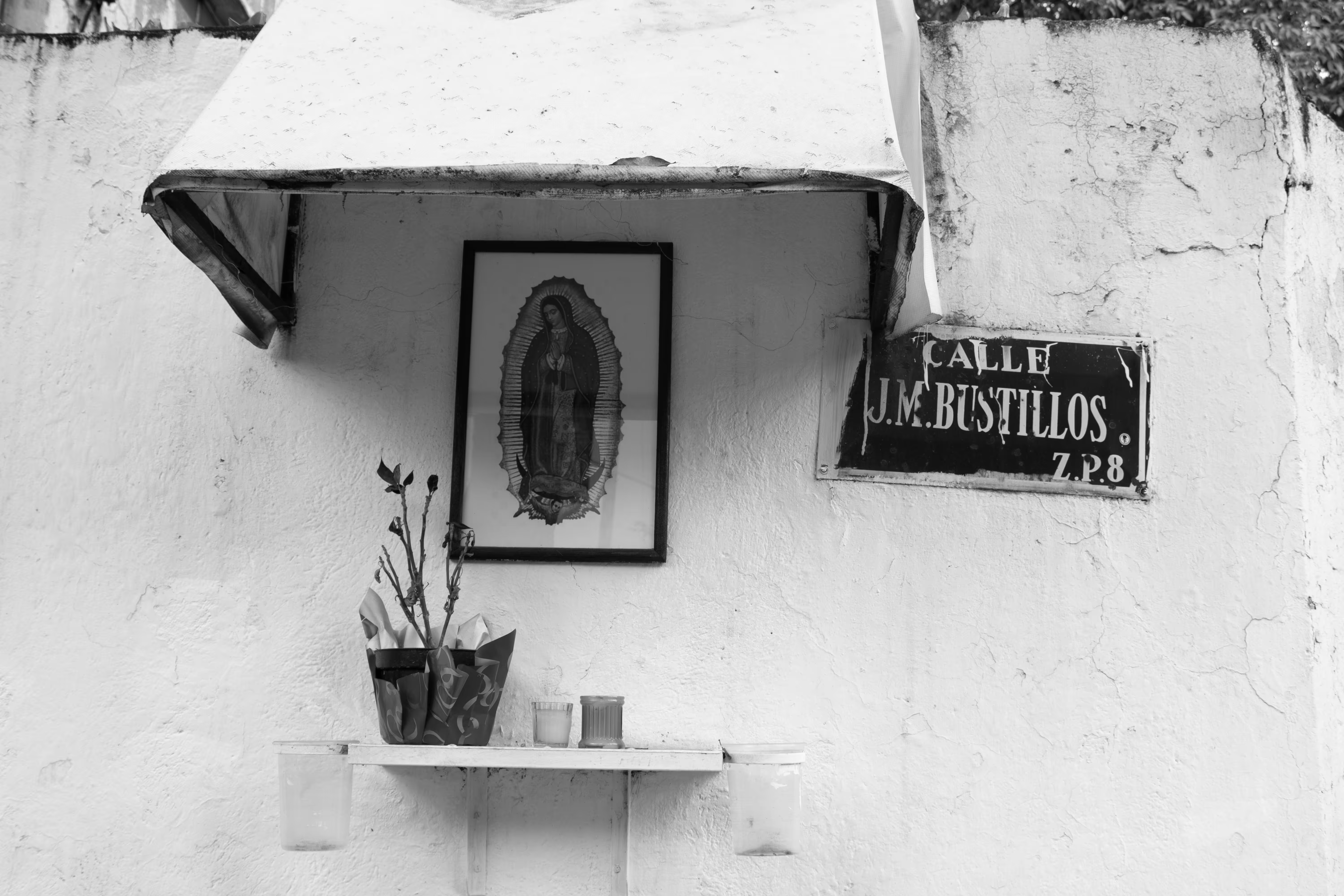
As Cristeros, we dedicate ourselves to a a life of true devotion to Jesus through Mary, particularly in the form of Our Lady of Guadalupe. Our Lady of Guadalupe, Pray for Us.
We begin our days with a Morning Offering dedicating our day:
O Jesus, through the Immaculate Heart of Mary, I offer you my prayers, works, joys and sufferings of this day, in union with the holy sacrifice of the Mass throughout the world, for the remission of my sins, for the intentions of my family and friends, and in particular for the intentions of the Holy Father. Amen.
At a high or low point during the day, we pray to the Holy Spirit, handing over our accomplishments or sufferings:
Come Holy Spirit, fill the hearts of thy faithful, and enkindle in us the fire of thy love, send forth thy spirit and we shall be created, and though shall renew the face of the earth. Amen.
At some point each day, on our own or with our family or friends, we pray to our Mother Mary in the form of Guadalupe, giving all that we have and are to Jesus through Mary by reciting one of the following:
- A daily Rosary, focusing on the Fruits of the Mystery.
- The Hail Holy Queen
Every night before we go to sleep, by ourselves or with our wife, we pray a nightly examine using the ACTS formula:
- Adoration: We adore you and Christ and we bless You, because by Your Holy Cross, You have redeemed the world.
- Contrition: Ask God for forgiveness for all the times you have sinned or fallen short that day,
- Thanksgiving: Thank God for all the gifts he has given you that day, including the grace for those moments you have acted virtuously and towards the Good.
- Supplication: We ask God for his blessings that night and the next day, either with particular requests or in general, and end with a prayer dedicating ourselves to Him through Our Lady of Guadalupe: All that we have and all that we are, we give to your hands Jesus, through the heart of Mary, your blessed mother. Amen. Our Lady of Gudalupe, Pray For us.
.png)
.png)