Relating to the Word Made Flesh
According to the Catechism, as we saw earlier this Advent, there are four general reasons why the Eternal Son of God took on our human nature. Meditating on each of them can help us as we end our Advent preparations today and begin our Christmas celebrations.
457 The Word became flesh for us in order to save us by reconciling us with God, who “loved us and sent his Son to be the expiation for our sins”: “the Father has sent his Son as the Savior of the world”, and “he was revealed to take away sins” (I Jn. 4:10; 4:14; 3:5):
Sick, our nature demanded to be healed; fallen, to be raised up; dead, to rise again. We had lost the possession of the good; it was necessary for it to be given back to us. Closed in the darkness, it was necessary to bring us the light; captives, we awaited a Savior; prisoners, help; slaves, a liberator. Are these things minor or insignificant? Did they not move God to descend to human nature and visit it, since humanity was in so miserable and unhappy a state? (St. Gregory of Nyssa, Orat. catech 15: PG 45, 48B.
458 The Word became flesh so that thus we might know God’s love: “In this the love of God was made manifest among us, that God sent his only Son into the world, so that we might live through him” (I Jn. 4:9). “For God so loved the world that he gave his only Son, that whoever believes in him should not perish but have eternal life” (Jn. 3:16).
459 The Word became flesh to be our model of holiness: “Take my yoke upon you, and learn from me.” “I am the way, and the truth, and the life; no one comes to the Father, but by me” (Mt 11:29; Jn 14:6). On the mountain of the Transfiguration, the Father commands: “Listen to him!” (Mk 9:7; cf. Dt 6:4-5). Jesus is the model for the Beatitudes and the norm of the new law: “Love one another as I have loved you” (Jn 15:12). This love implies an effective offering of oneself, after his example (Cf. Mk 8:34).
460 The Word became flesh to make us “partakers of the divine nature” (2 Pt 1:4): “For this is why the Word became man, and the Son of God became the Son of man: so that man, by entering into communion with the Word and thus receiving divine sonship, might become a son of God” (St. Irenaeus, Adv. haeres. 3, 19, 1: PG 7/1, 939). “For the Son of God became man so that we might become God” (St. Athanasius, De inc. 54, 3: PG 25, 192B). “The only-begotten Son of God, wanting to make us sharers in his divinity, assumed our nature, so that he, made man, might make men gods” (St. Thomas Aquinas, Opusc. 57, 1-4).
Each of these reasons is profound, and each has meaning for every one of us. They are all on display in some way at Christmas, and it is our joy and privilege to enter into each one of these, particularly in these last day before we celebrate the Nativity.
To that end, I suggest the following exercises, questions, and considerations for your prayer and preparation, that you may enter more fully into at least one of the reasons that Christ came for us. Take whichever may stand out to you, and pray with it. When you have come to conclusions, bring them to the Christ Child in the manger tonight or tomorrow and talk to Him about them. Talk to the Blessed Virgin and Saint Joseph, asking for their help as well. These are heavy considerations that follow, but when better to take them up than now, when we can bring them to an Innocent Child Who will receive and love us fully, and Whom we can approach without worry or fear, for He is such a small Child Who loves us and is there specifically for us? Go to Him. Stay with Him. Learn from Him.
The Word became flesh for us in order to save us by reconciling us with God
- Make a good and thorough examination of conscience and confession this Christmas season.
- Consider all the ways through your life that you have been brought back into right relationship with the Lord and with others.
- What needs to happen in your life to continue and further a reconciliation with the heavenly Father? What sins prevent that relationship? Where is grace and healing needed? Do you ask for that grace and healing in prayer and in honesty, or hide it in shame and confusion?
- Looking back to the St. Gregory of Nyssa quote above (first bullet), when I look at my life, soul, heart, and relationships, what sickness needs healing, fallenness needs lifting, tendency toward death needs life, closed-ness needs opening, darkness needs light, captivity needs freedom, imprisonment needs help, enslavement needs freedom? What steps need to be taken in Christ and in life to achieve those ends?
The Word became flesh so that thus we might know God’s love
- Consider how God shows His love specifically to you as His beloved son/daughter. What reminders do you see of this on a regular basis? Do you accept or reject God’s love when He offers it to you? How and why? Are you a conduit for His love or more like a dam on a river?
- Consider and meditate upon your identity as a beloved son/daughter. What detracts from your truest and deepest identity as a beloved son/daughter? What must change that your true identity is not hidden or marred? How you can better be a loving son/daughter of the Father, a loving husband/wife and father/mother, a loving man/woman?
- God’s love is also His life, peace, and truth, among other things. What prevents me from living fully and abundantly in Christ? What prevents me from having pervading peace and joy? Where I am not living in truth, or what lies have I come to believe?
The Word became flesh to be our model of holiness
- Consider the Beatitudes and the Ten Commandments, as well as how you need to grow in holiness. Are you trying to do so? By yourself or with God? How often do you pray?
- Do I try to live on my own or with and for Christ? Am I self-reliant or totally dependent on Him? How and why? Do I listen to Him or everything but Him?
- Is love my motivation, or rather fear, pride, anger, jealousy, gluttony, envy, sloth, lust, fame, power, and fortune? Where do I find fulfillment and contentment? Does my daily living, my schedule, my financial statement show that I am given to God or to other things?
- Am I comfortable or do the Cross and Christian sacrifice have a place in my life? If not, how will they become part of my life?
The Word became flesh to make us “partakers of the divine nature.”
- Consider your baptism and what that means for you as a Christian. Are you living up to your baptismal promises? What hinders you from doing so fully? How will you handle that? Are you helping others to live their baptismal promises, or hindering them?
- What are my true intentions and goals? Are they God and heaven, as well as anticipating and encountering those realities now? Or instead temporal, worldly goods?
The Cristeros Rule of Life
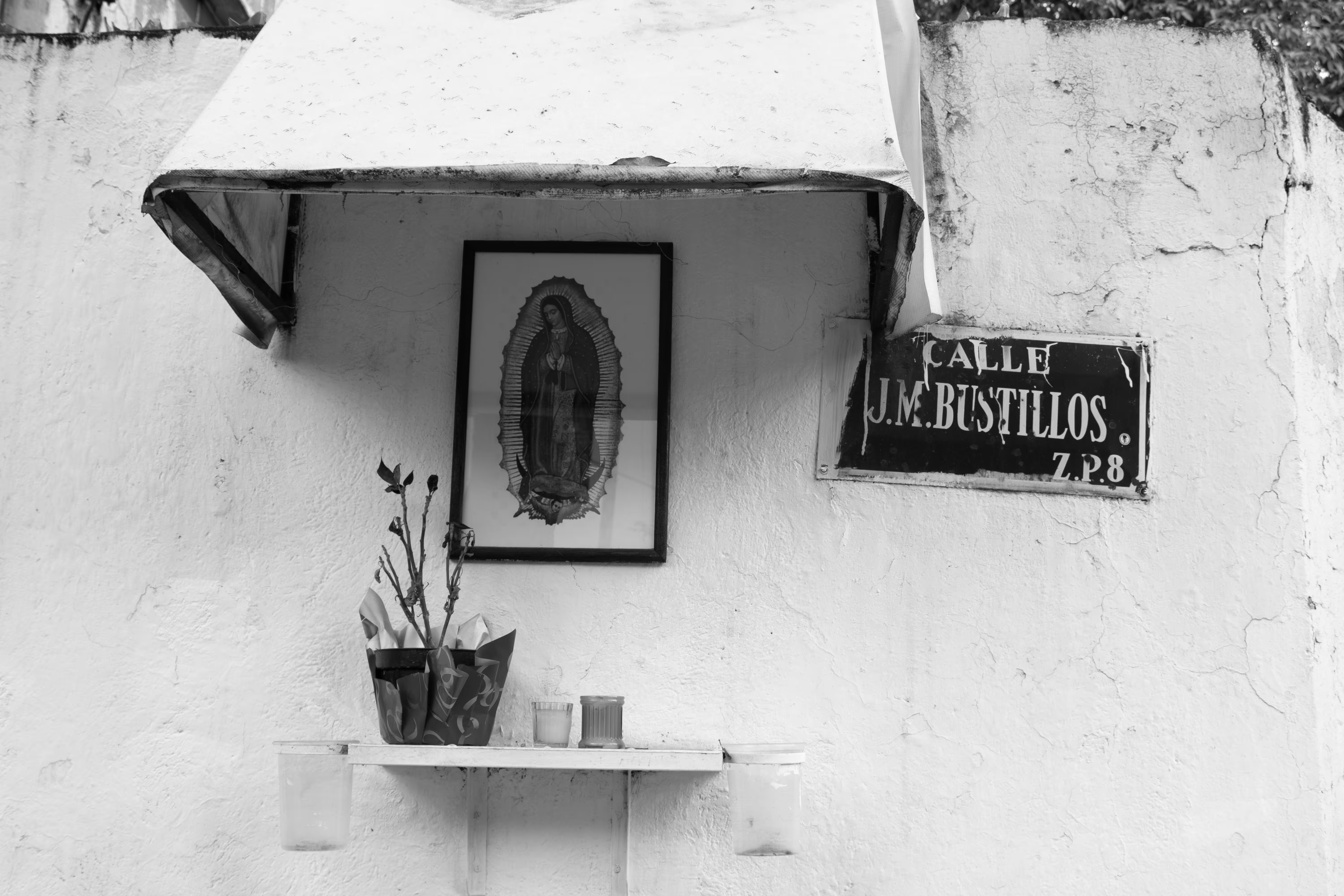
As Cristeros, we dedicate ourselves to a a life of true devotion to Jesus through Mary, particularly in the form of Our Lady of Guadalupe. Our Lady of Guadalupe, Pray for Us.
We begin our days with a Morning Offering dedicating our day:
O Jesus, through the Immaculate Heart of Mary, I offer you my prayers, works, joys and sufferings of this day, in union with the holy sacrifice of the Mass throughout the world, for the remission of my sins, for the intentions of my family and friends, and in particular for the intentions of the Holy Father. Amen.
At a high or low point during the day, we pray to the Holy Spirit, handing over our accomplishments or sufferings:
Come Holy Spirit, fill the hearts of thy faithful, and enkindle in us the fire of thy love, send forth thy spirit and we shall be created, and though shall renew the face of the earth. Amen.
At some point each day, on our own or with our family or friends, we pray to our Mother Mary in the form of Guadalupe, giving all that we have and are to Jesus through Mary by reciting one of the following:
- A daily Rosary, focusing on the Fruits of the Mystery.
- The Hail Holy Queen
Every night before we go to sleep, by ourselves or with our wife, we pray a nightly examine using the ACTS formula:
- Adoration: We adore you and Christ and we bless You, because by Your Holy Cross, You have redeemed the world.
- Contrition: Ask God for forgiveness for all the times you have sinned or fallen short that day,
- Thanksgiving: Thank God for all the gifts he has given you that day, including the grace for those moments you have acted virtuously and towards the Good.
- Supplication: We ask God for his blessings that night and the next day, either with particular requests or in general, and end with a prayer dedicating ourselves to Him through Our Lady of Guadalupe: All that we have and all that we are, we give to your hands Jesus, through the heart of Mary, your blessed mother. Amen. Our Lady of Gudalupe, Pray For us.
.png)
.png)